


Moving a business is not a bigger version of moving a house. The furniture might look similar once it is on the truck, but everything around it changes. You have staff who need somewhere to work on Monday morning, IT equipment that cannot sit in a van overnight, a landlord expecting the old space back in a certain condition, and a finance team asking why the quote reads the way it does.
That is the gap corporate relocation services are built to close. We plan the move as a project rather than a job, so your organisation keeps running while the premises change around it.
This guide covers what corporate relocation services actually include, how we approach corporate and government clients differently, what really drives the cost, and the questions worth asking before you appoint anyone. If you are coordinating a business move for the first time, you will finish with a clear picture of what good looks like.
What Corporate Relocation Services Actually Include
Corporate relocation services are end-to-end moving services for organisations, covering planning, packing, IT and furniture handling, transport, secure storage, reassembly and setup in the new premises. The point of difference is coordination. One team owns the whole sequence rather than three suppliers passing responsibility between them.
In practice, that means a site assessment before anything is quoted, an inventory of what is moving, a written move plan with timings, and a crew briefed on that plan before they arrive. Our commercial removals team also handles the parts most people forget, such as the desks that are being retired, the storeroom nobody has opened since 2019, and the meeting room joinery that needs careful handling.
Every corporate client is assigned a Personal Move Manager. That person is your single point of contact from the first walkthrough to the final desk being reassembled, which keeps decisions moving when something changes at short notice.
Why Corporate and Government Moves Are Planned Differently
Corporate relocation services and public sector work sit in the same family, but the pressures are not identical. A corporate move usually answers to an operations or facilities lead who cares most about continuity and cost. A government or council move usually answers to a procurement process, which means documentation, defined scope and a paper trail that survives an audit.
Both need the same thing from corporate relocation services: predictability. What changes is how that predictability has to be evidenced. For corporate clients we build the plan around trading hours and headcount. For government departments and councils we build it around approvals, reporting and access windows agreed in advance.
We have written separately about the compliance side of government moving services, including site inductions, crew identification and secure handling of sensitive material. If you are managing a public sector relocation, start there and treat this guide as the commercial layer that sits on top of it.
The overlap matters for a practical reason. Many organisations run both. A department with a corporate arm, a university with commercial tenancies, or a business bidding for government contracts will need a provider who can move comfortably between the two without relearning the process each time.
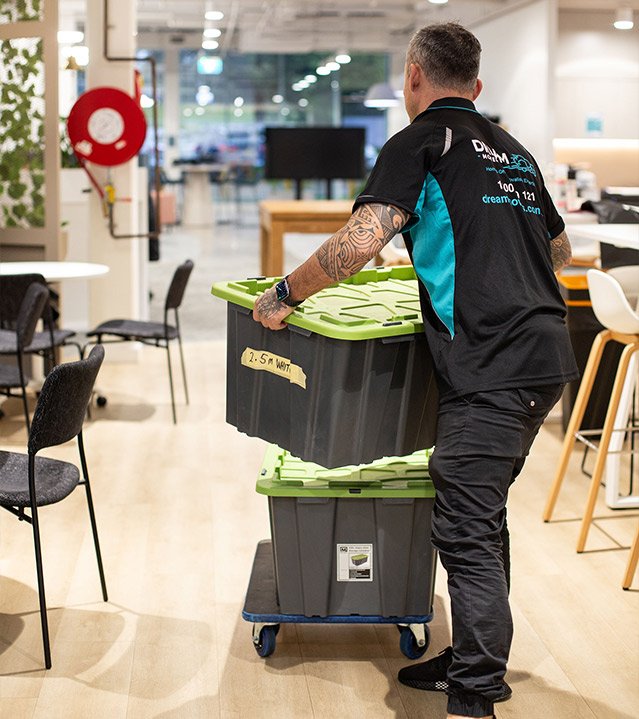
The Real Cost of a Corporate Move Is Downtime, Not the Truck
Most businesses compare corporate relocation services on the quoted figure. It is the wrong number to lead with, because it is rarely the biggest one.
Work it out with your own figures. Take your team size, multiply by an average daily cost per employee, and multiply again by the days you expect to be unproductive. For most offices, that total dwarfs the difference between two quotes. A cheaper mover that costs you an extra day of disruption has not saved you anything.
This is why we plan the sequence so carefully. The aim is not simply to shift the contents of a building. It is to have your people sitting down and working in the new space at the earliest sensible moment, with their equipment where they expect it to be.
That reframing also helps when you are seeking budget approval. A move presented as a continuity plan with a controlled cost tends to get signed off faster than one presented as a removal invoice.
How We Plan Corporate Relocation Services Around Your Operating Hours
The most common question we get from office managers is whether we can move outside business hours. Yes, and for most commercial jobs it is the better option. Evening, overnight and weekend moves let us take the bulk of the volume out while nobody is trying to work around us.
A typical staged plan looks like this. Non-essential storage and archives move first, often a week ahead. Furniture and workstations move on the Friday evening. IT and personal effects follow overnight. Setup and snagging happen on the Saturday, so Monday morning looks like an ordinary Monday morning.
Larger sites are moved zone by zone rather than all at once. We label by destination rather than by origin, which sounds like a small detail and saves hours at the other end.
Inventory First, Then the Truck
Good corporate relocation services start with a proper inventory. We walk the site, record what is moving, what is being stored, what is being disposed of and what belongs to the landlord.
That inventory drives everything else, including truck allocation, crew size, packing materials and the final quote. It also protects you at handover, because you have a documented list of what left the building. Our packing and unpacking service is scoped from the same document, so nothing gets counted twice.
Workstations, IT and the Reassembly Sequence
Workstations are the part that most often runs late. Screens, docks, cable trays and monitor arms all have to come apart in a logical order and go back together in the reverse one, which is why we photograph desk setups before they are dismantled.
Our crews handle disassembly and reassembly of office furniture, including bench systems, storage units and boardroom tables. Fitted joinery and bespoke pieces are treated separately through our joinery handling and delivery process, since they rarely survive being loaded like standard furniture.
Corporate relocation services only work when the technology side is planned alongside the furniture, so we coordinate with your IT provider on timing rather than working around them on the day. Servers, comms racks and anything with a disconnection or reconnection dependency get their own slot in the plan.
Storage for the Gap Between Leases
Lease dates almost never line up neatly. You may leave one premises on the thirtieth and take possession of the next on the eighth, or take a smaller floorplate and need somewhere for the furniture you are not ready to part with.
Corporate relocation services should cover that gap rather than leave you to solve it. Our secure furniture storage does exactly that. Items are inventoried, wrapped and stored, then delivered back on the date you nominate. For businesses downsizing their footprint, it also buys time to decide what is genuinely surplus rather than making that call in a hurry during the move.

Corporate Relocation Services in Sydney, Melbourne and Brisbane
We deliver corporate relocation services across Sydney, Melbourne and Brisbane, with our own fleet and directly employed, trained crews. That matters more on commercial work than residential, because the same people who quote your job are accountable for how it runs.
Multi-site organisations often move between cities rather than within one. Our interstate removals team handles head office relocations and branch consolidations with the same planning approach, adjusted for transit times and delivery windows.
For organisations whose needs extend beyond a single relocation, corporate relocation services can continue as an ongoing arrangement. We also work as a logistics partner on a continuing basis.
What to Ask Before You Appoint a Corporate Relocation Services Provider
Ask how far ahead you should book. Six to eight weeks gives us room to plan properly, secure the right crew size and lock in access. We regularly work to shorter timelines, so a compressed deadline is worth a conversation rather than an assumption.
Ask what drives the price. Volume, building access, lift availability, timing and how much packing you want us to handle are the main variables. A quote that ignores those is a quote that will change later.
Ask who is accountable on the day. You want a named contact who was at the site assessment, not a phone number that reaches a call queue.
Ask what happens if the plan slips. Buildings run late, keys arrive late, fitouts overrun. The right answer describes contingency, not optimism.
Ready to Plan Your Corporate Relocation?
Corporate relocation services are worth what they protect. A well-planned move gives your team back their working week, gives your finance lead a number that holds, and gives your landlord a space handed back in the condition your lease requires.
Businesses across Sydney, Melbourne and Brisbane have shared what it is like to move with us, and their Google reviews give you the clearest picture of how we work.
Tell us the sites, the headcount and the dates, and we will walk the space and build the plan around them. Request your free moving quote or speak with one of our move managers about your corporate or government relocation.